
Need for SPEED?
How the SPEED Act aims to overhaul environmental reviews—and why it’s sparking a partisan firestorm.

The Nutshell
The SPEED Act (Standardizing Permitting and Expediting Economic Development Act) is a nominally bipartisan legislation act that would fundamentally reform the National Environmental Policy Act (NEPA). The National Environmental Policy Act (NEPA) is a 1970 law that requires federal agencies to evaluate and disclose the environmental, social, and economic effects of major federal actions before making decisions, usually through environmental assessments or environmental impact statements and with opportunities for public comment. For energy infrastructure such as pipelines, power plants, and transmission lines that need federal permits, federal funding, or cross federal lands, NEPA functions as a central review step that can shape project design, add mitigation, or in rare cases delay or block projects if significant unaddressed impacts are identified. The SPEED Act seeks to limit the scope of environmental reviews, shorten lawsuit deadlines from six years to 150 days, and restrict how courts can challenge federal permitting decisions. While supporters claim it will accelerate critical energy infrastructure development, opponents argue it guts environmental protections and silences community voices. The bill passed the House Natural Resources Committee 25-18 in November 2025 but faces uncertain prospects in the Senate, where it would need 60 votes to overcome a filibuster.
Overview:
The SPEED Act, introduced by House Natural Resources Committee Chairman Bruce Westerman (R-AR) and Representative Jared Golden (D-ME), proposes the most significant changes to NEPA since the law was enacted in 1970. The legislation focuses exclusively on reforming NEPA procedures and judicial review processes rather than addressing other permitting bottlenecks.
Key provisions include limiting agencies to evaluating only environmental impacts with “a reasonably close causal relationship” to the project under consideration, excluding speculative or cumulative effects. The bill raises the threshold for federal involvement from “sufficient control” to “complete control and responsibility” over funded projects, potentially exempting many federally supported infrastructure projects from NEPA review.
The SPEED Act would sharply constrain judicial review—imposing a 150-day deadline to sue, channeling cases to courts of appeals, and instructing courts to give agencies ‘substantial deference,’ which in practice would make it harder to overturn permits than under the traditional ‘arbitrary and capricious’ standard. The statute of limitations for lawsuits drops from six years (for energy projects) to just 150 days, and courts would have 180 days to issue final judgments. Perhaps most controversially, projects could proceed even while violations are being corrected on remand, creating a “bulldoze first, consider impacts later” scenario.
The legislation applies to all types of energy infrastructure, including solar, wind, storage, natural gas, petroleum, geothermal, hydro, coal, and nuclear projects. It would affect pipelines, electrical transmission lines, power plants, and other energy infrastructure requiring federal permits or approvals.
Arguments for:
Supporters argue the SPEED Act addresses genuine delays in the permitting process that are preventing critical infrastructure development. Jason Grumet, CEO of the American Clean Power Association, stated that the SPEED Act “reforms are necessary to develop all forms of American energy infrastructure enabling a comprehensive response to soaring energy demand” and that “absent these improvements and additional efforts to support pipeline and transmission infrastructure, energy prices will spike and system reliability will be threatened”.
Proponents contend the bill simply codifies recent Supreme Court precedent, particularly the Seven County Infrastructure Coalition v. Eagle County decision, which limited NEPA’s scope to direct project impacts rather than upstream and downstream consequences. The bill’s supporters claim it brings needed clarity to an ambiguous process that has been exploited for delay tactics by NGOs (non-governmental organizations), tribal groups and local opposition groups within communities. With electricity demand surging from AI, data centers, manufacturing reshoring, and electrification, supporters argue America cannot afford years-long permitting timelines that are typical under current law.
Supporters also argue that the SPEED Act would increase predictability and investment certainty for energy projects by narrowing NEPA’s scope and putting firm timelines and limits on litigation. They contend that aligning environmental review more closely with recent Supreme Court precedent and focusing on direct project impacts will reduce “kitchen-sink” lawsuits that raise far-removed or speculative harms, which in turn drive up financing costs and scare off capital for long-duration projects. From this perspective, clearer rules, shorter windows to sue, and greater deference to agency experts are not about weakening safeguards, but about making sure that once a project has run the regulatory gauntlet, developers, utilities, and ratepayers can rely on those decisions and move ahead with construction.
Centrist arguments:
Centrist observers acknowledge permitting reform is needed but question whether the SPEED Act strikes the right balance. The Bipartisan Policy Center’s analysis notes that while the reforms “are likely to make it easier to build energy infrastructure in the U.S.,” there is “much more work to be done to overhaul our permitting process in a meaningful and lasting way”.
Some moderate voices recognize that recent legislative changes, including the Fiscal Responsibility Act of 2023, already made significant NEPA reforms with enforceable timelines. The Inflation Reduction Act provided over $1 billion for NEPA implementation, and data from the Council on Environmental Quality shows agencies have been completing reviews significantly faster in recent years. For example, the Department of Energy cut Environmental Impact Statement timelines in half during the previous administration. This raises questions about whether more aggressive reforms are necessary or premature.
The case study of the TransWest Express transmission line highlights uncertainties about the SPEED Act’s effectiveness. Despite taking 16 years to permit, the Niskanen Center’s analysis found the SPEED Act “likely would not have protected TWE from this delay” since the litigation challenge stemmed from reasons unrelated to NEPA disputes. This suggests the bill may not address the actual causes of many permitting delays.
State and federal authority tensions create additional complications. While the SPEED Act reforms federal NEPA procedures, it does not address the fundamental jurisdictional issues around energy infrastructure, particularly interstate transmission lines. States retain primary authority over transmission siting, and no amount of NEPA reform changes the reality that “multi-state transmission lines are permitted through a patchwork of state-by-state decisions with no single entity accountable for getting a project across the finish line”.
Arguments against:
Environmental and community groups strongly oppose the SPEED Act, arguing it fundamentally undermines environmental protection and public participation. Over 100 organizations signed a letter stating the bill “would enact sweeping, severe changes to the National Environmental Policy Act (NEPA) and prioritize private profit over the public interest, reduce government accountability, and disregard the voices and welfare of communities impacted by federal decisions”.
Critics point out that the premise underlying the SPEED Act is flawed. Less than 0.25% of NEPA decisions result in litigation, according to agency data. The Congressional Research Service has repeatedly concluded that NEPA is not a primary or major cause of delay in project development, identifying instead lack of funding, changes in project design, and other factors outside the NEPA process. Environmental justice advocates emphasize that the bill would disproportionately harm frontline communities.
Specific provisions draw sharp criticism. The requirement that agencies meet “the goals of the applicant” when defining project purpose and need fundamentally shifts federal decision-making from public interest to private profit.
The prohibition on challenging categorical exclusions is particularly concerning given that these account for 95% of NEPA actions. Opponents note that the Deepwater Horizon disaster was approved via a categorical exclusion, and under the SPEED Act, such decisions could never be challenged.
Notable Quotables
Supporters:
Marty Durbin, President, Global Energy Institute, U.S. Chamber of Commerce: “This bipartisan legislation takes critical steps to reforming a permitting system that too often chills investment, creates uncertainty, and increases costs and delays for essential energy infrastructure projects. The legislation reduces delays and provides greater confidence for investments in energy infrastructure by establishing clear permitting milestones and reinforcing the certainty of fully permitted projects”.
Centrist/Moderate/Nuanced:
Bipartisan Policy Center (institutional assessment): “On net, these reforms are likely to make it easier to build energy infrastructure in the U.S. However, there is much more work to be done to overhaul our permitting process in a meaningful and lasting way. The proposed changes in the SPEED Act are likely to be considered as part of a broader bipartisan permitting package that is currently being negotiated in Congress”.
Opponents:
Mahyar Sorour, Senior Policy Director, Sierra Club Beyond Fossil Fuels Program: “Americans would greatly benefit from harnessing the country’s ample clean, renewable energy resources to lower costs and provide a more reliable and resilient grid. The SPEED Act would move us in the wrong direction, allowing developers to prioritize profit without consideration of community or environmental harm. We can move quickly to build out our clean energy future without undermining our clean air and water, healthy communities, and our collective prosperity”.
Watt we don’t know:
1. Whether the SPEED Act would actually reduce permitting timelines for the projects that matter most. The TransWest Express case study suggests the bill might not address the real bottlenecks. That 16-year transmission project faced delays primarily from lack of interagency coordination and non-NEPA litigation, neither of which the SPEED Act would have substantially resolved. Without addressing state-by-state permitting for interstate transmission or establishing clearer federal siting authority, major infrastructure projects may still face years of delays regardless of NEPA reforms.
2. How state laws and permitting requirements would interact with federal NEPA reforms. The SPEED Act only reforms federal environmental review under NEPA, but states retain primary authority over siting most energy infrastructure, particularly transmission lines. California, for example, has the longest statutory timeline of all western states for approving transmission projects, with no expedited permitting pathways. Individual state environmental laws (like California’s CEQA), state public utility commission requirements, and local zoning ordinances would remain unchanged by federal NEPA reform. This means that even with streamlined federal review, projects could still face lengthy state processes, potentially negating much of the SPEED Act’s intended acceleration.
3. Whether the changes to judicial review would survive legal challenges and what unintended consequences might result. The SPEED Act’s dramatic restrictions on judicial review, including changing the standard from “arbitrary and capricious” to “abuse of discretion,” the 150-day statute of limitations, and allowing projects to proceed during remand, represent unprecedented changes to administrative law. Legal scholars may argue these provisions unconstitutionally limit judicial review or violate due process. Additionally, if agencies know their decisions cannot be effectively challenged in court, it could lead to lower-quality environmental reviews, more mistakes in permitting decisions, and potentially more project failures or environmental disasters after construction begins.
Our take:
The SPEED Act reflects a genuine tension between the urgent need to build energy infrastructure at scale and the importance of environmental protection and community input in federal decision-making. While permitting timelines are undeniably too long for critical projects, and NEPA reviews have accumulated decades of complexity, the SPEED Act may be too blunt an instrument that addresses symptoms rather than root causes. The most significant question is whether dramatically restricting environmental review and judicial oversight will actually speed the projects America needs most, or whether it will simply trade one set of problems (delay from litigation) for another (poorly planned projects that fail or face renewed challenges). The bill’s fate in the Senate remains uncertain, as it would need 60 votes to overcome a filibuster, and Democrats wielding that power are unlikely to accept its more aggressive provisions without significant modifications.
If one focuses on just NEPA alone, there is an argument to be made that “it was broken, and we are fixing it.” As shown in the figure below by the Council on Environmental Quality (2025), shorter approval times are real, as indicated by the decrease in time from when a company files a Notice of Intent (NOI) under NEPA rules to the time when a Environmental Impact Statement (EIS) has been issued. These changes mainly come from new statutory deadlines and regulatory guidance that cap review times and encourage more efficient documents and combined decisions. Additional funding from the Inflation Reduction Act has allowed agencies to hire NEPA staff, build specialized permitting teams, and improve coordination, directly addressing long-standing capacity constraints. Agencies like DOE and DOT have also streamlined their own procedures, using better project management, standardized templates, and early scoping to cut completion times for many EIS by roughly a quarter to one-half.
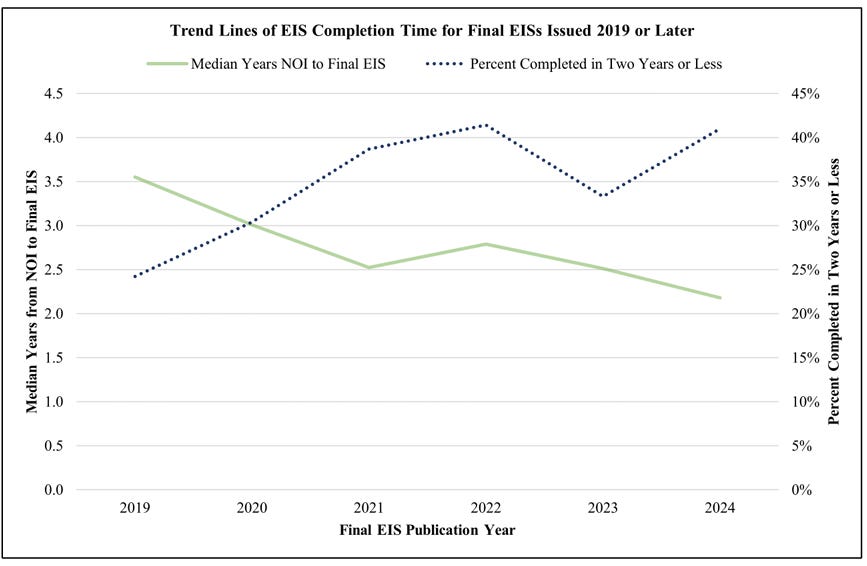
Will this upward vector continue? Likely not. Multiple experts and datasets indicate that large federal workforce reductions under the current Trump administration have directly reduced staffing capacity for NEPA and permitting work at key agencies.
Analyses by former Federal Permitting Improvement Steering Council director Eric Beightel argue that reductions in force and a “4:1” replacement ratio are stripping away the experienced NEPA and permitting staff that had been built up with earlier bipartisan infrastructure and IRA funding, undermining efforts to improve permitting efficiency and slowing agencies’ ability to update NEPA procedures and manage complex reviews.
Reporting on the 2025 mass layoffs notes that agencies central to environmental review and energy infrastructure (such as DOE, Interior, EPA, and others) have lost thousands of employees, with observers warning that the loss of seasoned subject-matter experts and project managers is already weakening permitting capacity and will make it harder to meet aggressive review timelines set in recent reforms.
As such, many detractors feel this is a Republican attempt at an end-around…effectively, the process will be streamlined by less oversight, as required by the leaner and less experienced staff left in the wake of the cuts by the Trump administration.
Though this bill has been touted as being bipartisan, the fact that only 2 Democratic House committee members supported the bill indicates that the bill will almost certainly face headwinds getting beyond the filibuster in the Senate. In fact, Senate Democrats have begun drafting their own legislation to address permitting reform. For example, the SITE Act would grant FERC (Federal Energy Regulatory Commission) federal siting authority for major interstate transmission lines, creating a “one-stop shop” to overcome the fragmented state-by-state approval process that currently stalls grid expansion. The companion SPEED and Reliability Act aims to streamline reviews by eliminating duplicative DOE and FERC assessments and funding grid infrastructure, while House Democrats have pushed to modify the SPEED Act to protect public input and judicial oversight. Overall, the strategy emphasizes empowering agencies with clearer federal authority, better funding for staffing, and modern digital tools to speed up decisions without gutting core NEPA protections.
Even though the US desperately needs regulatory and permitting reform, there is growing divergence on what that means and how it should be implemented. Without significant changes, the SPEED Act is going nowhere fast. It is clear that NEPA is not the sole culprit behind US permitting woes, and other issues must be considered as well. Republicans have so far prioritized unilateral rollbacks and narrower permitting changes over a comprehensive bipartisan package, decreasing the chance of meaningful (and durable?) permitting reform. As the US continues to spin its wheels, China will plow forward with its own plan and benefit from federal mandates and lax regulatory and environmental rules. The result? The lack of bipartisan effort in the US will decrease the chance of meaningful permitting improvements…and this risks widening an already large gap with China’s much more centralized, top-down permitting and siting system.
Points to Ponder
If the United States needs to build unprecedented amounts of new energy infrastructure to support economic growth, national security, and energy affordability, how can we balance environmental protection with the reality that our current system takes 4-15+ years to permit major projects?
What happens to accountability when corporations can “bulldoze first, consider impacts later” because courts can no longer effectively stop projects that violate environmental laws?
Given that the SPEED Act reforms federal NEPA procedures but doesn’t address state siting authority, interstate coordination challenges, cost allocation disputes, or interagency resource constraints, will this legislation actually accelerate the specific infrastructure projects America needs most (like interstate transmission lines), or are we focusing on the wrong bottleneck?
Watt happens next?
The House will likely vote on the SPEED Act before year-end 2025 or early 2026, with Chairman Westerman indicating he wants floor action soon. Given the bill’s bipartisan House support (though limited to moderate Democrats like Golden and Gray), it has reasonable odds of House passage.
Senate consideration faces significant hurdles, requiring 60 votes to overcome a filibuster. Senate Energy and Natural Resources Committee and Environment and Public Works Committee are drafting their own permitting reform proposals and do not view the SPEED Act as their starting point. Senate Democrats led by Martin Heinrich (D-NM) and Sheldon Whitehouse (D-RI) are working on alternative approaches.
Negotiations toward a broader permitting package are likely, as the SPEED Act may be modified and combined with other proposals (such as transmission-specific reforms like the SPEED and Reliability Act or elements of the 2024 Energy Permitting Reform Act). The final product could look substantially different from the current House bill, potentially addressing transmission siting authority, cost allocation, and other issues the current bill omits.
The legislative window is narrow, closing by late 2026 at the latest. As the 2026 election season intensifies, bipartisan cooperation becomes increasingly difficult. Energy industry observers suggest the realistic timeline runs from now through Thanksgiving 2025, with a possible push before Christmas, and then a brief window in early 2026 before election politics dominate.
Regardless of congressional action, executive branch permitting reforms will continue. The Trump administration has issued multiple executive orders on permitting modernization, including technology updates for the 21st century and designation of energy infrastructure as national priorities. Federal agencies including DOE, FERC, and EPA are implementing administrative changes that may achieve some of the SPEED Act’s goals without legislation.
Dig Deeper
Bipartisan Policy Center: What’s in the SPEED Act?
https://bipartisanpolicy.org/issue-brief/whats-in-the-speed-act/
This comprehensive explainer provides detailed analysis of specific provisions, context on prior permitting reforms, and redlined text showing exactly what would change in NEPA law.
The Breakthrough Institute: The Fall of Permitting Reform
https://thebreakthrough.org/issues/environmental-regulatory-reform/the-fall-of-permitting-reform
This analysis evaluates multiple permitting reform proposals including the SPEED Act, offering centrist critique of what works and what doesn’t in current approaches.
Environmental Integrity Project: Permitting Reform Myths & Effective Pathways Forward
https://www.eli.org/sites/default/files/files-pdf/55.DispellingTheMyths.pdf
This resource examines common misconceptions about NEPA and permitting delays, presenting data on what actually causes bottlenecks and offering alternative reform principles focused on agency capacity, coordination, and meaningful public engagement.
The TransWest Express case study really undercuts the premise here. If a 16-year delay stemmed from issues outsdie NEPA disputes, then reforming NEPA won't fix the actual bottleneck. The deeper problem is that federal reforms dont touch state siting authority, which is where most transmission delays actually happen. California's timeline alone can stretch years regardless of federal review speed. Without addressing the state-by-state patchwork or establishing clearer federal coordination, we're basically optimizng the wrong part of the process.